Emma Goldman Finishing School

Click Here to view the Emma Goldman's Image Gallery

phone: 206/324-6822

address:
1309 13th Ave. S.
Seattle, WA 98144

email: egfs@riseup.net

web: egfs.org


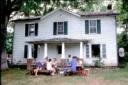
Founded in 1996, the Emma Goldman Finishing School is an intentional community in the North Beacon Hill neighborhood of Seattle. Formerly known as the Beacon Hill House, we changed our name in November 2003.

Our community is based on the principles of societal change, egalitarianism, non-violence, ecology, simplicity, community living. Our home is a fun and supportive place to live, and it is also an institution working to build economic, political, and cultural alternatives. We see ourselves as part of a growing infrastructure designed to oppose and replace the dominant system. As an egalitarian community, we value our labor equally.

Some of us work more hours at jobs which bring in money, others work more around the house and on community projects. Regardless, we all contribute equal time. Every member is able to have all their basic needs met by the community, including food, shelter, transportation, health care, and retirement.

Currently, the community consists of eight residents, five women and three men, ranging in age from their mid twenties to late forties. We are writers, musicians, socal workers, activists, gardeners, dancers, educators, anarchists, nurses, queers, geeks, unionists, kayakers ,artists, athletes, and revolutionaries.

We currently have openings for 4 long-term members, and are especially interested in folks in their 30s, 40s, 50+s. Although we work to maintain gender and age balance and to preserve our community's values and politics, we welcome all ages, ethnicities, abilities, orientations, and class.

For more detailed info about who we are, check out our website

Emma Goldman Finishing School


Below are stories, blogs and articles on Emma Goldman's Finishing School.

Elder Care Business Opportunities

Greetings,

Incredible opportunities exist for egalitarian communities to participate in the elder care industry. The elderly are the fastest growing segment of society and in desperate need of care on many levels. Personal wealth & government benefits make them an abundant & reliable source of income and it's work you can feel good about - helping people truly in need.

A google search will amaze you with information from turn-key franchises to totally do-it-yourself operations. Opportunities range from one person "in-their-own-home" visiting care services to full-service elderly housing facilities. The possibilities are endless.

There are requirements for accountability, certification, licensing, & etc. which many may find too oppressive to deal with. But, if reliable income derived from helping others is a goal of your community, elder care may be a source worth investigating.

Food for thought.

Feeling Adventurous

Thank you all for your help. Monday July 13th I am leaving from Dayton, TN and heading to Highland, Arkansas to the "Love Light" community. I will be hitch hiking there with a 50-75lb. hiking pack and tent. Well, if I don't talk to you all for a while it is because I am on the road of adventure. I really like the community I have found and am eager to get on the road. If you are looking for a community and are new all I can tell you is that if you are really serious about it just start checking the communities directory on this site and keep looking until you find one that interests you, . . . then just go for it when you got the chance to. I hope all have a good one. Till I talk to you later, arrivaderchi for now.
Your Friend,
SeekerOfTheGreenLife
Josh Nordyke

Emma's Community Report

Happy spring from Emma’s! And it is starting to feel like spring here in Seattle. Yesterday the sun was out in full force, people were walking the streets in shirtsleeves, and the cherry trees and daffodils have bloomed. The warmer air (and rain ?) are a welcome change from what was a winter of abnormal snow. In December and January we had snow that shut down the city! At first the urban winter wonderland was a fun change that had us all inside crafting, cooking, eating, relaxing with our friends and fellow communards. But after a few weeks, that got old.

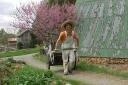
So now we’re busy planning our garden for the summer, cover-cropping, composting, starting seedlings. Along with a group of other urban farmers that calls itself Food Not Lawns, Marc built a greenhouse at a collective house a short walk away, so now we have a place to nurture our baby plants. In addition, our neighbor is letting us use part of his yard as garden space, so we’re looking forward to an even bigger garden this year. We’re also still participating in the collective farm Shoulder to Shoulder, growing some of our produce on Vashon Island.

This winter we also were able to host many great guests, including family and friends of our members, past Emmunards, friends in the wider communities movement in the region, and activists from the arts education collective The Beehive who were in town on their national tour. You can check out their work at www.beehivecollective.org.

The last couple of months have felt empty at Emma’s with Johanna, Sheldon, and their daughter Ruby on leave in Vermont. After the passing of Sheldon’s mother, they decided to spend a few months with their family on the East Coast, connecting with loved ones there and having a break from life-as-usual in Seattle. We’ll be happy to have them back home in May.

Emma Goldman Finishing School Community Report

This past year has been one full of changes. The biggest being the birth of our first baby, Ruby, who is the daughter of Johanna and Sheldon. As a community, we’ve been learning how to support new parents, how to do baby sign language, and how to relate with this little one. It has been a challenging and rewarding learning opportunity for us. Now, Ruby is walking/tottering and that is bringing with it a whole new set of fun and challenging things.

Also, we have seen some dramatic membership flux. After taking on two new adult members and two children in the fall of 2007, in the summer of 2008 one of our adult couples, and our new member and her two children moved on. So there was that. But we also had the blessing of bringing on our newest member Wilson. That brings us to our current membership of 7 adults (Sheldon, Johanna, Addy, Monica, Marc, Patience, Wilson) and 1 Ruby, which means we have 5 rooms available.

We decided to open up two of the rooms for non-membership-seeking subletters, and have Marc’s partner Tamara filling one room, and our past member Thea (also of Sandhill) in the other for the winter months. We’re excited to have their upbeat energy and great skills around Emma’s.

Each year, we are expanding our own food production, and this year we joined a collective farm on Vashon Island, which is just a ferry ride away. We have 1 out of 8 shares, where we put in $400 upfront, do 6 hours of a labor a week, and get our share of the harvest. That in addition to what we grow in our own garden has made it so that we have a pretty decent produce supply in the summer months. We’re planning on continuing this next year.

Emma Goldman's Finishing School in YES Mag

Check out this article in YES Magazine:
http://www.yesmagazine.org/article.asp?ID=2098

A Taste of Freedom at Home

by Adam & Kibby MacKinnon

“I want freedom, the right to self-expression, everybody's right to beautiful, radiant things.”

Emma Goldman (1869-1940)
WRITER AND ACTIVIST

Let's say you're a typical wage-slave: you work a 40-hour week—at least 160 hours a month—on top of which you've got a nasty, desensitizing commute. What little time you have left you spend feeding yourself, and then collapse in front of a DVD.

Come Together, Emma Goldman's Finishing School in This Magazine

Highly organized and efficient—and far from being marginal, they're
tackling some of today's most puzzling social problems. Cheri Hanson
tours a few of the best examples.


By Cheri Hanson, This Magazine


What do intentional communities look like? Maybe your mind has
already hit image overdrive: hippie crash pads littered with bongs;
tie-dye decor; Jimi Hendrix wafting through the marijuana haze;
blenders clogged with organic sludge; dogs, goats and chickens ranging
around a ramshackle farmyard; dysentery.


Clichés? Absolutely. And in today’s intentional communities,
these scenarios are not just stereotypical—they’re completely
inaccurate. Across North America, and around the world, thousands of
people are living collectively. Rather than dropping out of mainstream
society, many of these groups are committed to revolution from within.
Some even work closely—take a deep breath here—with their local
governments, rather than rallying against them. Clearly, the times they
are a-changing.


“All through history, intentional communities have been like
society’s research and development centres,” says Geoph Kozeny, a U.S.
community consultant, filmmaker and self-proclaimed zealot for the
co-operative living cause. Despite often being “seen as weird,” says
Kozeny, alternative community-builders are pioneers searching for new
ways to address ongoing human concerns. Economics, environmental
sustainability, urban alienation—these are hardly fringe issues.


Every group has its own vision, but rather than surrendering
their lives to social accident, intentional communities are all
tackling human challenges with practical idealism—tie-dye and daisy
wreathes optional.


COMMONS SENSE


From the outside, the Cranberry Commons development in Burnaby,
B.C., looks like any other family-oriented condo project. The neutral,
peak-roofed buildings hug an inner courtyard littered with toys and

Syndicate content