The FEC is a union of egalitarian communities which have joined together in our common struggle to create a lifestyle based on equality, cooperation, and harmony with the earth.

Log On and join our Online Community! Tell your stories and share your dreams and community experiences. Ask us questions about our communities. Help us build a better world!

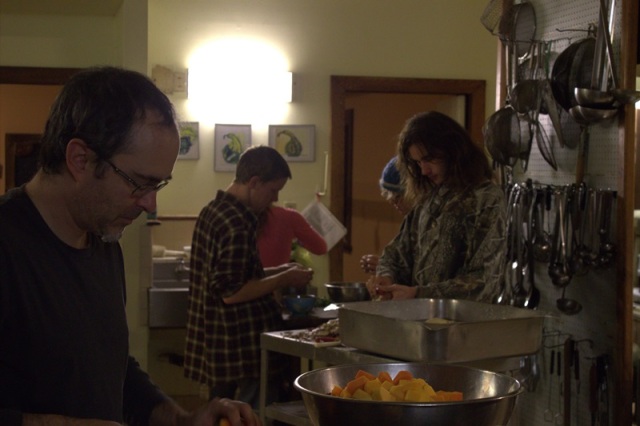
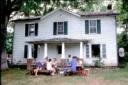
Emma Goldman Finishing School Community Report

This past year has been one full of changes. The biggest being the birth
of our first baby, Ruby, who is the daughter of Johanna and Sheldon. As
a community, we’ve been learning how to support new parents, how to do
baby sign language, and how to relate with this little one. It has been
a challenging and rewarding learning opportunity for us. Now, Ruby is
walking/tottering and that is bringing with it a whole new set of fun and
challenging things.

Also, we have seen some dramatic membership flux. After taking on two
new adult members and two children in the fall of 2007, in the summer of
2008 one of our adult couples, and our new member and her two children
moved on. So there was that. But we also had the blessing of bringing
on our newest member Wilson. That brings us to our current membership of
7 adults (Sheldon, Johanna, Addy, Monica, Marc, Patience, Wilson) and 1
Ruby, which means we have 5 rooms available.

We decided to open up two of the rooms for non-membership-seeking
subletters, and have Marc’s partner Tamara filling one room, and our past
member Thea (also of Sandhill) in the other for the winter months. We’re
excited to have their upbeat energy and great skills around Emma’s.

Each year, we are expanding our own food production, and this year we
joined a collective farm on Vashon Island, which is just a ferry ride
away. We have 1 out of 8 shares, where we put in $400 upfront, do 6
hours of a labor a week, and get our share of the harvest. That in
addition to what we grow in our own garden has made it so that we have a
pretty decent produce supply in the summer months. We’re planning on
continuing this next year.

On the project front this past year, we’ve taken care of a fews
small-medium projects, including refinishing our dining room and main
hallway floor, by sanding it down and varnishing it. We took the

Acorn Community Report

Well, 2008 has been a wild year for Acorn. We've seen some significant changes in our membership and our businesses.

Seed businesses across the USA have been seeing phenomenal growth rates this last year and our own Southern Exposure Seed Exchange has been no stranger to the trend. Overall, sales have increased by something like 50% for the year with some of our historically slower months seeing their sales double or more over last year. It could be rising fuel and food prices, a maturing organics and green movement, all the promotion that we've been doing this last year, or just a good old fear of the apocalypse. Or some combination thereof. Speaking of promotion, this year, on the first Saturday in September, we held our second annual Heritage Harvest Festival with Monticello, Whole Foods, and the Master Gardeners. We fretted and worried when the tropical storm decided to roll through our area precisely on Saturday morning but were stunned when an estimated 1000+ people came out and braved the rain with us. This year also saw us purchasing Garden Medicinals and Culinaries, a seed company specializing in herbs, off the same fellow we purchased SESE off of some 10 years ago.

August Flowers

August was great for flowers. I planted dozens of sunflowers back in June, and they were real happy by the time I got back to the farm August 1st. The butterflies were happy, the Japanese beetles were happy... and my camera, too. There was one towering, massive, shoulder-leafed mammoth sunflower that nodded you down the driveway and provided a welcome shelter to dozens of beetles.

There were darker sunflowers, sultry and mysterious, brooding and deeply vibrant in their rich bronze tones. Some of the sunflowers were edible, and I'm sure the birds appreciated the gesture. The darker sunflowers are my Mom's favorite.

After so many weeks of summer and brilliance, the sunflowers were disced into the fields to provide nutrients to the soil for fall plantings and cover crops.

Accountability & Punishment

One of the hardest things for people to handle well is critical feedback about their behavior. No one enjoys finding out that others are having a problem with something you've said or done, and there's an amazing array of things people do to keep feedback at bay—many of which are far more clever then the standard alliterative trio of defensiveness, denial, or deflection.

(Let me tell you of a great scheme I had working for a number of years, until a careful observer busted me on it. Whenever someone criticized me, I'd start beating myself up, often with more vigor than I was approached with. Horrified by how hard I was on myself, people near me learned to be careful about giving me feedback, for fear of triggering my next display of self-flagellation. Most people stopped giving me critical feedback, or at least curtailed it sharply. Then, of course, I couldn't be held responsible for not heeding feedback I'd never been given. Oh, it was plenty clever.)

And yet we need feedback—especially critical feedback—to understand more accurately how our words and deeds are landing. If you're not sure about this, think about how important pain is to maintaining health. If you step on a nail, it's a damn good thing that your foot hurts. I'm not saying it's good that you're in pain; I'm saying that it's good that pain alerts you to look at your foot, so you can take the nail out. There is as analog with behavior. While you'd prefer that people have a positive response to what you do, it's valuable to know when they don't because it's information you'll want to weigh before deciding whether to repeat that behavior. If you don't get the information, it's of no use to you.

Fun Facts About Twin Oaks Energy Consumption

I am working on my NASCO Institute presentation for this year, and came up with these figures. Enjoy!

Gasoline:

The average American uses about 500 gallons per year.(1)
Twin Oaks consumed about 15,267 gallons of gas in 2007.
With an average population of 87 adults, that would put our consumption at 175 gallons per person.
That is 65% less gas consumed!

Electricity:

The average American uses 11,000 kWh of Electricity per year.(2)
Twin Oaks consumed 268,065 kWh in 2007.
With an adult population on average of 87 adults, that would put our consumption at 3,083 kWh per person.
that is 73% less electricity consumed!

Natural Gas:

The average resident in Virginia uses 767 therms of natural gas.(3)
Twin Oaks consumed 16,221 therms of natural gas in 2007.
With an adult population on average of 87 adults, that would put our consumption at 186 therms per person.
that is 76% less natural gas consumed!

This is a great example of the power of sharing.
Cheers!

Working with Work

A couple blogs back I wrote about Untangling Hair Balls (Sept 23 entry), which was based on recent work I'd done with East Lake Commons (ELC) in Atlanta on the topic of Work/Participation. I got response froma reader that he'd like to hear more about what the starnds of that particular hair ball looked like. (I figure you gotta reward a person who leans into a hair ball for a closer look—mostly people just go "yuck!" and wonder why the cat couldn't have done that outdoors.)

Okey doke. Here's my sense of the key questions a group will have to address on the topic of Work/Participation. Note: while some of these questions are specific to residential communities, many are not, and the issue of Work/Participation can plague any group.

A. Should everyone in the group be expected to contribute to the well being and development of the group?
B. If yes, do you want to quantify that expectation (for example, hours/month)?
C. Do you want to record contributions? If so, how?
D. What is the point of this expectation? To get the work done, to build relationships among members, or both?
E. To what extent, if any, is it OK that dollars be substituted for hours? (Hint: the answer here will be highly dependent on how you answer Question D.)
F. Is it OK that one member donate hours to cover another who is working less? If so, are there any limits on this?
G. Can members "bank" hours (by working more than expected for one stretch, and then less in expected in another stretch)?

Sorghum Season!

At Sandhill today we cooked our first sorghum of the 2008 season. (Can fall colors be far behind?) It was a beautiful day, with temps in the lows 80s. We made about 50 gallons of satisfyingly light syrup, and have already filled several cases of the new crop in our distincive 1-lb and 1-quart jars. A good start.

Ten days ago it was hard to imagine that conditoons would be so favorable. Our fields were totally saturated with the 6+ inches of rain that fell in the aftermath of Hurricane Ike. For the first time in more than 15 harvests it was beginning to look like we were going to have to trudge through the mud to extract the cane, and that we wouldn't be able to drive on the fields. However (cross your fingers), that didn't happen. The skies cleared after the deluge ended Sept 14, we stop working on an ark, and it hasn't rained since. We've been lucky.

In addition, we have a crew of eager labor exchangers from Twin Oaks, our sister community in Virginia, who are helping us this opening week of the season—swarming the fields like locusts, pulling down the leaves, cutting the stalks with machetes, and stacking the cut cane in little piles, where they await the wagons that will collect it for the ride to the mill. Sorghum season is a social highlight of our calendar. Based on the notion that many hands make light work, this is the month when we most encourage people to visit, turning drudgery into festival. While it's a logistical challenge finding tent space for everyone and keeping the ravenous harvest crew fed from our community gardens, it's a labor of love. Our aim is to turn complexity into conviviality, and for the most part we succeed.

Untangling Hair Balls

Last week I was in Atlanta (at East Lake Commons) to deliver Weekend I (of eight) of the two-year training I’m offering with my wife—Ma’ikwe Ludwig—in Integrative Facilitation. In exchange for hosting the weekend, the home community had the chance for outside facilitation of meetings on real issues (I figure the students learn much faster facing live bullets than through reading, watching demonstrations, or practicing role plays).

In this case, East Lake Commons selected a community favorite: Work/Participation. It’s probably the single topic I have the most experience navigating as a process consultant. In fact, almost all cooperative groups struggle with this one.

In addition to being a volatile topic (one in which emotional distress is common), it’s also a complex topic. That makes it a double whammy, and it’s no wonder that groups struggle with it. While it was a tough nut for the students to attempt to crack in Weekend I, it also offered an abundance of teaching moments, one of which I want to share in this blog: a model for tackling a complex topic (aka “a hair ball”), based on the old military strategy of “divide and conquer”:

Step 1: Identify all the questions that need to be addresses (the interwoven strands of the hair ball).

You know you've lived on a commune when...

You know you've lived on a commune when...

...you share a Netflix subscription with 4 or more people.

...you have no idea what Netflix is

...you or a member of your family has ever answered to the name Sage,
Harmony or Rainbow

...you know the Briggs-Meyer, Enneagram or Aryuvedic dosha type of
everyone you live with

...you've ever given or received feedback while naked, with someone
other than your lover

...you share a checkbook with 5 to 75 other people

...dinner conversation turns to reminiscing about your favourite
McDonalds food before you stopped eating there. The longest-term
member thinks they ate there once in the 80's.

...you cringe at the phrase "high impact", because you want to get as
far away from those people as possible, or because you *are* one of
those people

...you've ever organized an orgy by consensus

...you've decided when to hold a retreat based on the most auspicious
astrological reading

...your household income breaks down to either $75 a month, or
$250,000 annually, depending on how you look at it

Eight of the above are true for Valerie, who wrote this.

Feedback for the New Website

The new FEC Website has been up and running for 6 months now. How do you like the site? Do you find the content interesting and informative? What could we do better?

Please give us your feedback! Post a comment on this topic, or email us at secretary@thefec.org.

Thanks!

Sometimes It Gets Worse Before It Gets Better

Ten days ago I was working with Monan's Rill, a 35-year-old Quaker-based community near Santa Rosa CA. Started in 1973 (just one year before my community, Sandhill Farm) they were unusual in that the founders were mostly in their 50s, inspired to build an intentional community in their "retirement" years. (I put that in quotes because I can hardly imagine a more demanding and consuming endeavor than creating a successful community from the ground up—yet that's what they did. The founders were fireballs, who did not go gentle into that good night.)

In any event, now the founders are all gone. Either passed away or relocated to assisted living, where the daily demands of getting around are less physically rigorous. For the members who comprise Monan's Rill today, there's a question about who the community is and where is it headed, which is part of the reason they invited me in.

I was asked to focus on two main things: 1) getting greater clarity about what non-monetary contributions are expected of members toward the development and well being of the community; and 2) how to work constructively with conflict when it emerges among members and complicates an issue. I was asked to both get traction on the thorny topic of Work/Participation and to provide a model for dealing with complex and volatile issues in general. For the 24 hours I'd be working with them (about 10 hours of plenary meetings), there was no danger of running out of things to talk about.

Sailing the Seven C's

I'm preparing a talk that I'll give this evening at Friends House, a Quaker retirement facility in Santa Rosa CA. As part of it I'll be talking about how to build community. In wrestling with how to organize my material (and be entertaining at the same time), I've hit upon the rubric of the Seven C's, which I'm test driving here:

1. Communication
The key here is developing the ability to listen accurately. Of course, it also helps to be able to be clear and concise in stating your own views, yet hearing well is crucial. Doing this well typically means developing a range of ways to communicate (styles and formats), so that you are using a language that is comfortable and easily understood by others. If making the connection is important, then be prepared to travel most of the way to others, instead of making them come to you.

Factors here include slang, time of day, how long you speak without pausing for the other person to respond, eye contact... even how close you are physically to the other person. There's a lot to this!

2. Curiosity
How interested are you (or more to the point, how interested do you appear to be) in what others are saying, especially if they have views that are different than your own. The more genuinely welcoming you can be, the better this is going to go. Please understand that I'm not saying you have to agree with someone to be curious about how they got there.

3. Courage

honey harvest

The harvest is usually the culmination/high point of any crop. With vegetables, fruits, grains, etc, the harvest often comes at one time; but the bees gather honey whenever they can. So then the issue is: when do you decide to harvest honey? Most folks harvest at the end of the “honey flow”, which varies depending on where you are. We are in the middle of the mid-west (northern Missouri) and our honey flow is usually mid May to end of July - mid August (depending on rainfall & weather). We normally harvest at the end of August. By that time, they will hopefully have capped most of the honey and it still gives them plenty of time to bring in fall honey for their winter stores.

There are 2 distinct parts to the honey harvest: getting the honey from the beehives and to extract the honey from the frames in the boxes. How do we get the bees out of the boxes of honey? We use a commercial product called Bee Go which is basically a bee repellent: it is smelly and unpleasant so the bees try to get away from it. We apply it to a cloth inside of a lid which we put on the hive. The bees go down in the hive allowing us to examine the frames to make sure we are taking honey and not brood. (Using bee go is the one thing we do which is not allowed in organic production. I choose to do it because of the various methods I have tried it feels the most humane to the bees - fewer bees get wounded or crushed than other ways I have tried)

Twin Oaks & Television

I have a three-lettered acronym that comes in handy as a process consultant: OBE. (No, it doesn’t mean Order of the British Empire, though that’s a useful bit of crossword trivia.) In my argot, it means “overtaken by events.” I use it to describe situations that are difficult to resolve, yet which become moot when circumstances shift.

For example, learning how to type accurately was an important secretarial skill when people relied on the technology of mimeograph machines to create inexpensive copies (it was an absolute booger correcting mistakes on a stencil, necessitating costly delays). Today, in the era of high-speed photocopiers, no one uses stencils. With computer word processing and inexpensive printers, it’s no big deal to rework a document and crank out a fresh original if someone discovers a typo. Although it’s more important today that everyone learns to type—it’s hard to imagine functioning without email or access to the Web—the need to type accurately is largely OBE.

In general, people live in intentional communities with the purpose of altering their lifestyles to something more in line with their values than they can readily find among mainstream options. It’s what makes them “intentional.” While communities vary substantially in where they draw their lines, for the purpose of this article I want to focus on the history of television at Twin Oaks, which is a well-established income-sharing community in central Virginia that celebrated its 41st anniversary last June. Twin Oaks members have always been deliberate about how much they let outside culture seep into their environment, and yet the floodgates are never closed completely.

Growing green manure crops

Growing green manure crops is the key to maintaining soil fertility at Sandhill Farm. A green manure crop is planting a crop to feed the organisms and web of life in the soil: usually, the crop is turned under and incorporated when it is in the flowering stage - at that time, the plants reach their greatest biomass. It is just before seed begins to form, at which time plants use a lot of their own resources and the soil to grow the seed.

We grow at least one green manure crop for every crop that we harvest; sometimes two or three. The photo is of a buckwheat/soybean green manure crop: the soybeans have the large dark green leaves; the buckwheat is flowering. I wish you could hear the sounds - buzzzzzzz - our honey bees love these flowers and the entire field hum. This crop is only 4 weeks old - that’s a lot of biomass we will be incorporating into the soil in a week or two. It will make a lot of soil organisms very happy.

After this crop, we will plant our winter green manure crop - wheat, hairy vetch, oats, & buckwheat. The buckwheat will die with the first frost, the oats will be killed after repeated hard frost - usually Dec-Jan, and the wheat and vetch go dormant in the winter and grow again next spring. The oats and buckwheat put out a lot of biomass in the fall. When they die, the wheat and vetch take over.

Radical Culture Shock: The Desire for Community and the Need for Private Space

A. Allen Butcher, Denver, August 2008

For conversations on this material readers are invited to join an email list:

http://groups.yahoo.com/group/thefecwide/join
or
Send an email to: thefecwide-subscribe@yahoogroups.com

You Share What?!

What is the most shocking thing about communal society? Different people may answer that question in different ways. For some it may be income-sharing and the resulting freedom from dependence upon any one person or upon the nuclear family for one’s economic well-being, as is the norm in the dominant culture. For others it may be the social acceptance of having multiple or other non-traditional sexual partners, yet for most people, however, it could be something much more basic to human nature.

This paper is a follow-up to two others I’ve written recently, the first being about the change in the ideology that Kat Kinkade espoused as the reason-for-being of the member communities of the Federation of Egalitarian Communities, Twin Oaks, East Wind and Acorn, which she co-founded. (See: http://www.thefec.org for: “Kat Kinkade and the Communal Theories of Equality and of Sharing.”) Over the decades Kat realized that striving for equality was problematic, even though it was she who invented the most effective form of communal economic system, the vacation-credit system. Over time she realized that the tendency toward leveling everyone to the same amount of economic consumption was not conducive to social harmony. Kat wrote, “Secular communal economies must, to be successful, be full of holes. I think that if they are too tight, too ‘equal,’ they will fail, because people would not be able to stand the constraints. ... Most people value small liberties more than they value small equalities, and therefore society works better if the rules aren't too rigid. Equality is a means, not an end.” (Kinkade, "Is It Utopia Yet?" 1994, p. 47, 50)

Breaking daddy out of jail

“You’ve done this twice before, I have problems also with Dominion’s nuclear stuff, but why do you have to break the rules?” the magistrate from Orange County was angry, referring to my two prior US trespassing offenses at the Exelon Headquarters outside of Chicago and Vermont Yankee reactor complex.

“This is not the only thing I do to try to stop this reactor. I am a Dominion stock holder, I go to every shareholders meeting and talk with senior management about the problems with this proposal. I write letters to the editor, I lobby the county supervisors, I work with organizations which lobby in Washington…”

“Good, so why do you have to break the rules?” He interrupts exasperated.

“Because these things are not effective enough. It is like Martin Luther King fighting for civil rights.”

“I don’t want to talk about that.” He dismissed

“You asked me why, I’m telling you.”

Job Opening: PEACH FUZZ - Independant Facilitator for PEACH

PEACH is looking to fill the FUZZ position within its structure. We are soliciting applications and recommendations for the following job:

To apply or make a recommendation, please email us at jobs@theFEC.org .

PEACH FUZZ

( Facilitator with Urbanity, Zeal, and Zest )

Required time commitment: approx. 10-100 hrs/year

The following skills and characteristics are desired of the PEACH FUZZ:

o Good communication skills, both orally and in writing
o Experienced in conflict resolution, consensus, and group dynamics.
o Able to bridge effectively between different viewpoints
o Able to constructive and creatively work different viewpoints
o Good work habits
o Able to handle criticism .
o Has the time and motivation to do the job.
o Comfortable with email, conference calls, and other forms of electronic communication.

The FUZZ will have the following responsibilities & duties:

o Monitoring all communication to ensure appropriate consensus process is being followed, all concerns are being recognized and dealt with, and that the tone of the communication is respectful and productive.

o Intervening when conflict arises and assisting in resolving the conflict. While the FUZZ is expected to exercise discretion about when co intervenes, they have the authority to pro-actively investigate whenever co feels something may be amiss.

o Maintaining regular contact with all participating communities, particularly with the MELBAs, their Back-ups, and others concerned with health care issues.

o Encouraging MELBAs to regularly solicit input from their home community about PEACH operations, and reminding each participating entity to periodically evaluate their MELBA's performance.

o Ensuring proper process is followed by the MELBAs, the PIT, and the SEED when making decisions.

Kat Kinkade and the Communal Theories of Equality and of Sharing

Allen Butcher, July 2008 (EW ’75-’83, TO ’85-’89)

For conversations on this material readers are invited to join an email list:

http://groups.yahoo.com/group/thefecwide/join
or
Send an email to: thefecwide-subscribe@yahoogroups.com

***

This paper presents in Kat Kinkade’s own words her invention of the vacation-credit communal economic system, and her later abandonment of the ideals of equality and communalism due to her concerns about envy and the lack of personal incentive. This paper only addresses Kat’s comments on economic issues of labor and money, while her views on politics and decision-making require a separate paper.

Kat co-founded three communal societies, Twin Oaks (TO), East Wind (EW) and Acorn, and named its networking association the “Federation of Egalitarian Communities.” In Kat’s later disillusionment with communal society may be found inspiration for changing the emphasis in communal theory from equality to sharing, and for developing new experiments in communitarian design.

***

Kat in “Journal of a Walden Two Commune,” from “Walden House Newsletter,” Aug, 1966, p. 8

The holding of property in common at Walden House is not an article of dogma. We don’t do it because it was recommended by Jesus or Marx. We do it because it saves money and makes sense. Where it ceases to have these functions, we cease to practice it.

Kat in “Journal of a Walden Two Commune,” from “Walden House Newsletter,” Aug, 1966, p. 14

Equality in a community is a relationship so structured that no member envies another. Simple.

Power and Structure

Wednesday—the last day of meetings discussing the future of PEACH [see my July 4 and July 13 blogs for more about this]—we tackled a tough issue around communication guidelines. There have been problems with the program representatives not always adequately informing their home communities what’s going on or soliciting member input before making program decisions. To what extent should we be attempting to address those concerns by requiring more steps for the representatives and administrators to take before making decisions, and to what extent should the burden of responsibility fall on the communities who have either not been making great selections in their representatives, or not holding them accountable for fully informing the community of what’s going on?

I’m worried that the easier solution is to shackle the administrators (asking for more frequent reports; not allowing decisions to be made unless everyone has voiced an opinion [that is, not allowing silence to be interpreted as assent]; dividing the administrative tasks into more jobs, so no single person is as powerful; pushing for more structure and limiting individual discretion), which is an example of addressing a power disparity by hamstringing those perceived as more powerful, rather than focusing on strengthening the weak spots. I don’t think it's a good approach.

That said, it’s still a real dilemma how to reasonably strengthen the community representatives. Most of the work is clerical, with the occasional need for serious consideration about a tough issue—around which tens of thousands of dollars may hinge. It’s hard to assign your best people to this job because of the low amount of challenging work, and yet it can be highly expensive to not have a heavy hitter in there when a hair ball comes along.

Syndicate content